
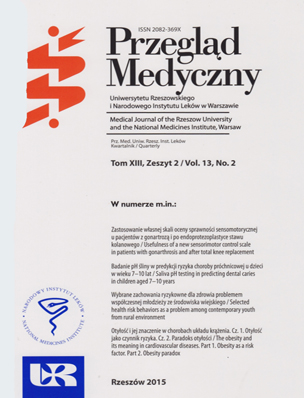
Usefulness of a new sensorimotor control scale in patients with gonarthrosis and after total knee replacement
DOI:
https://doi.org/10.15584/przmed.2015.2.3Keywords:
proprioception, total knee replacement, arthroplasty, knee osteoarthritis, sensorimotor system, sensorimotor controlAbstract
Introduction. The importance of sensorimotor control assessment as a crucial factor determining functional recovery is being increasingly appreciated in clinical practice. The aim of this study was to assess the influence of damage associated with severe gonarthrosis on changes in proprioception and sensorimotor control of the knee, compare the results of a new sensorimotor control test developed by the authors with objective methods of proprioception assessment, and analyse the relation between the level of proprioception and sensorimotor system function and the measurements used in clinical practice.
Material and methods. We studied a group of healthy persons (control group, n=74), patients with stage 4 knee osteoarthritis (group 1, n=67), and patients after total knee arthroplasty (group 2, n=62). The participants were assessed with a new sensorimotor control test (TKS) and a joint position sense test (JPS). Moreover, we analysed the patients’ HSS knee scores and Staffelstein scores.
Results. In the Control Group, mean TKS and JPS test scores were 4.9 pts and 3.9°, respectively, while the respective results in group 2 were 3.7 pts and 6.7° (p<0.005). In group 1, the TKS score was 3.2 pts and the JPS test result was 8.2° in the unaffected limb and 10.2° in the affected limb. The results of this group were significantly worse than the scores achieved in the control group and group 2 (p<0.005).
Conclusions. 1. The new knee sensorimotor control test developed by the present authors appears to provide an objective and comprehensive method to evaluate sensorimotor control of the knee in patients with gonarthrosis and after total knee replacement. 2. Further studies of the new test are advised, including an objective evaluation of the test utilising specialised measuring tools.
Supporting Agencies
This study was financed with MUW Young Researcher Grant No. 2F1/PM21/11Downloads
References
Riemann BL, Myers JB, Lephart SM. Sensorimotor system measurement techniques. J Athl Train 2002; 37: 85-98
Segal NA, Glass NA, Felson DT i wsp. The effect of quadriceps strength and proprioception on risk for knee osteoarthritis. Med Sci Sports Exerc 2010; 42: 2081-2088. doi: 10.1249/MSS.0b013e3181dd902e
Baker V, Bennell K, Stillman B, Cowan S, Crossley K. Abnormal knee joint position sense in individuals with patellofemoral pain syndrome. J Orthop Res 2002; 20: 208-214. doi: 10.1016/S0736-0266(01)00106-1
Bennell KL, Hinman RS, Metcalf BR i wsp. Relationship of knee joint proprioception to pain and disability in individuals with knee osteoarthritis. J Orthop Res 2003; 21: 792-797. doi: 10.1016/S0736-0266(03)00054-8
Wada M, Kawahara H, Shimada S, Miyazaki T, Baba H. Joint proprioception before and after total knee arthroplasty. Clin Orthop Relat Res 2002; 403: 161-167. doi: 10.1097/00003086-200210000-00024
Słupik A, Kowalski M, Białoszewski D. Aloplastyka stawu kolanowego a jego sprawność sensomotoryczna. Ortopedia Traumatologia Rehabilitacja 2013; 15: 555-565.
Słupik A, Białoszewski D. Analiza porównawcza przydatności klinicznej skal Staffelstein Score i Hospital for Special Surgery Knee Score (HSS) w ocenie wczesnych wyników endoprotezoplastyk stawu kolanowego. Doniesienie wstępne.
Ortopedia Traumatologia Rehabilitacja 2007;9(6):627-635.
Słupik A, Białoszewski D. Analiza porównawcza przydatności klinicznej skal Staffelstein-Score i Hospital for Special Surgery Knee Score (HSS) w monitorowaniu procesu fizjoterapii po zabiegu endoprotezoplastyki stawu kolanowego – doniesienie wstępne. Ortopedia Traumatologia Rehabilitacja 2009;11(1):37-45.
Hurley MV, Scott DL, Rees J, Newham DJ. Sensorimotr changes and functional performance in patients with knee osteoarthritis. Annals of the Rheumatic Diseases 1997; 56: 641-648.
Levinger P, Menz HB, Wee E i wsp. Physiological risk factors for falls in people with knee osteoarthritis before and early after knee replacement surgery. Knee Surg Sports Traumatol Arthrosc 2011; 19: 1082-1089. doi: 10.1007/s00167-010-1325-8
McChesney JW, Woollacott MH. The effect of age-related declines in proprioception and total knee replacement on postural control. J Gerontol A Biol Sci Med Sci 2000; 55: M658-666. doi: 10.1093/gerona/55.11.M658
Mouchino L, Gueguen N, Blanchard C i wsp. Sensori-motor adaptation to knee osteoarthritis during stepping-down before and after total knee replacement. BMC Muskuloskeletal Disorders 2005; 6: 21.
Downloads
Published
How to Cite
Issue
Section
License
Copyright (c) 2015 Medical Journal of the Rzeszow University and the National Medicines Institute, Warsaw

This work is licensed under a Creative Commons Attribution 4.0 International License.
Our open access policy is in accordance with the Budapest Open Access Initiative (BOAI) definition: this means that articles have free availability on the public Internet, permitting any users to read, download, copy, distribute, print, search, or link to the full texts of these articles, crawl them for indexing, pass them as data to software, or use them for any other lawful purpose, without financial, legal, or technical barriers other than those inseparable from having access to the Internet itself.
All articles are published with free open access under the CC-BY Creative Commons attribution license (the current version is CC-BY, version 4.0). If you submit your paper for publication by the Eur J Clin Exp Med, you agree to have the CC-BY license applied to your work. Under this Open Access license, you, as the author, agree that anyone may download and read the paper for free. In addition, the article may be reused and quoted provided that the original published version is cited. This facilitates freedom in re-use and also ensures that Eur J Clin Exp Med content can be mined without barriers for the research needs.











