
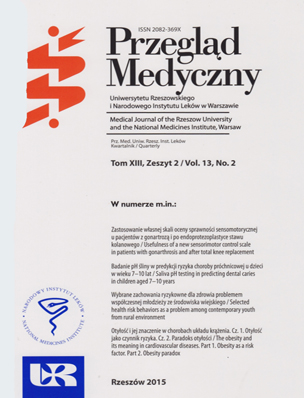
Selected health risk behaviors as a problem among contemporary youth from rural environment
DOI:
https://doi.org/10.15584/przmed.2015.2.8Keywords:
psychoactive substances, tobacco, alcohol, health behaviorsAbstract
Introduction: Engaging in risky behaviors is typical amongst adolescents. Psychoactive substances, i.e. nicotine, alcohol and other stimulants constitute one of the greatest threats to health of children and young people.
Aim: The purpose of this article is to present the issue of psychoactive substances abuse, such as tobacco and alcoholic beverages, by adolescents from rural environment.
Material and methods: Research encompassed a representative population of adolescents aged 15-19 from rural areas (total of 984 subjects) as well as their parents from a randomly selected poviat [Polish administrative unit, similar to district] in the West-Pomeranian voivodship. Author’s own questionnaires (surveys) were used. The information obtained from questionnaires were encoded and analyzed with a computer. The statistical analysis of correlations included Pearson’s chi-squared test, Cramér’s V and Spearman’s rank correlation coefficient.
Results: The research suggested that a significant number of adolescents smoke tobacco and drink alcohol. Smoking depends on the sex of subjects: boys are more likely to smoke (15.52%) than girls (10.62%). As for alcohol, the opposite tendency was observed. Girls drink more frequently (59.12%) than boys (54.87%). A correlation between alcohol consumption and parents’ education was observed (the more educated parents, the higher alcohol consumption – 67.35%); another observable dependency was noted between financial situation of the household/income and alcohol (the higher income per family member, the higher alcohol consumption – 23.76%).
Conclusions: A large proportion of adolescents from rural environment use psychoactive substances (such as tobacco and alcohol). The research identified correlations between this behavior and selected descriptive variables, such as: sex, parents’ education, financial situation of the household and income per family member.
Downloads
References
Barnekow R, Rasmusse V, Rivett D. The European Network of Health Promoting Schools – an alliance of health, education and democracy. Health Edu 2000;2:61-63. doi: 10.1108/09654280010312397
Krajewski W, Siuda K, Kaczmarek K. Promocja zdrowia oparta na dowodach. Przegl Epidemiol 2006;60:823–833.
Zatoński WA, Przewoźniak K, Sułkowska U, West R, Wojtyła A. Tabacco smoking in countries of the European Union. Ann Agric Environ Med 2012;19(2):181–192.
Beam M, Ehrlich G, Black JD, Block A, Leviton LC. Evaluation of the Healthy Schools Program: Part II. Role of Technical Assistance. Preventing Chronic Dis 2012;9:18-24. doi: 10.5888/pcd9.110105
Amadeo M, Kurtz N, Cutter HS. Abstinence, reasons for not drinking and life satisfaction. Int J Addict 2003;27(6):707-716. doi: 10.3109/10826089209068762
Jakubik A, Brodniak W, Pałyska M, Radzy J, Welbel S. Psychospołeczne uwarunkowania nikotynizmu. Alkoh Narkom 1995;4:90-102.
Mazur J, Woynarowska B. Współwystępowanie palenia tytoniu i picia alkoholu w zespole zachowań ryzykownych u młodzieży szkolnej. Tendencje zmian w latach 1990-2002. Alkoh Narkom 2004;18:1-2.
Borucka A, Ostaszewski K. Wiodące szkolne strategie profilaktyki używania substancji psychoaktywnych. Wychowanie na co dzień 2004;10-11:35-38.
Jodkowska M. Czy istnieje związek między postrzeganiem swojego zdrowia a zachowaniami zdrowotnymi. Przegl Ped 1999;29:314–318.
Sygit M, Sygit K. Wychowanie zdrowotne. Wyd. Nauk Uniw Szczeciński 2008.
Boyle P. Improving Health in Central and Eastern Europe. Ann Agric Environ Med 2011;18: 281–282.
Beam M, Ehrlich G, Black JD, Block A, Leviton LC. Evaluation of the Healthy Schools Program: Part I. Interim Progress. Preventing Chronic Dis 2012;9:11. doi: 10.5888/pcd9.110106
Woynarowska B, Mazur J. Zachowania zdrowotne młodzieży szkolnej: wyniki badań HBSC 2002. Zdrow Publ 2004;114(2):18-20.
WHO Report on the Consultation: Development of a WHO global strategy on diet, physical activity and health: European regional consultation, Copenhagen 2003.
Sygit M. Zdrowie publiczne. Wolter Kluwer Polska Sp. z o.o. Warszawa 2010.
Foster JH, Marshall RJ, Peters TJ. Comparison of the quality of life of cancer patients and alkohol dependents. Qual Life Res 2007;6:646-648.
Szymborski J, Szamotulska K, Sito A. Zdrowie naszych dzieci. Instytut Matki i Dziecka, Warszawa 2000.
Słońska Z. Promocja zdrowia jako strategia rozwiązywania współczesnych problemów zdrowotnych. W: Szymborski J, (red.). Zdrowie publiczne i polityka ludnościowa. Warszawa, Rządowa Rada Lud 2012;2:110–118.
Zatoński WA, and the HM project team. Epidemiological analysis of health situation development in Europe and its causes until 1990. Ann Agric Environ Med 2011;18:194–202.
Macnab A, Kasangaki A, Gagnon F. Health Promoting Schools Provide Community-Based Learning Opportunities Conducive to Careers In Rural Practice. Int J Family Med 2011;4:5–7. doi: 10.1155/2011/892518
Ifanti AA, Argyriou AA, Kalofonos HP. Health promotion education politics and schooling: The Greek case. Educ Res Rev 2011; 10:671–67.
Da Silva Vargas IC, Sichieri R, Sandre-Pereira G, Da Veiga GV. Evaluation of an obesity prevention program in adolescents of public schools. Rev Saúde Pública 2011;45:33–38.
Longenecker R, Zink T, Florence J. Teaching and Learning Resilience: Building Adaptive Capacity for Rural Practice. A Report and Subsequent Analysis of a Workshop Conducted at the Rural Medical Educators Conference, Savannah, Georgia, May 18, 2010. J Rural Health 2012;4:122–127.
doi: 10.1111/j.1748-0361.2011.00376.x
Kapka-Skrzypczak L, Bergier B, Diatczyk J, Niedźwiecka J, Biliński P, Wojtyła A. Dietary habits and body image perception among Polish adolescents and young adults – population based study. Ann Agric Environ Med 2012;19:299–308.
O’Grady ET, Hanson Ch, Rudner Lugo N, Hodnicki D. Unleashing the Nation’s Nurse Practitioners. J Rural Health 2012;28(1):1–3. doi: 10.1111/j.1748-0361.2010.00349.x
Downloads
Published
How to Cite
Issue
Section
License
Copyright (c) 2015 Medical Journal of the Rzeszow University and the National Medicines Institute, Warsaw

This work is licensed under a Creative Commons Attribution 4.0 International License.
Our open access policy is in accordance with the Budapest Open Access Initiative (BOAI) definition: this means that articles have free availability on the public Internet, permitting any users to read, download, copy, distribute, print, search, or link to the full texts of these articles, crawl them for indexing, pass them as data to software, or use them for any other lawful purpose, without financial, legal, or technical barriers other than those inseparable from having access to the Internet itself.
All articles are published with free open access under the CC-BY Creative Commons attribution license (the current version is CC-BY, version 4.0). If you submit your paper for publication by the Eur J Clin Exp Med, you agree to have the CC-BY license applied to your work. Under this Open Access license, you, as the author, agree that anyone may download and read the paper for free. In addition, the article may be reused and quoted provided that the original published version is cited. This facilitates freedom in re-use and also ensures that Eur J Clin Exp Med content can be mined without barriers for the research needs.











