
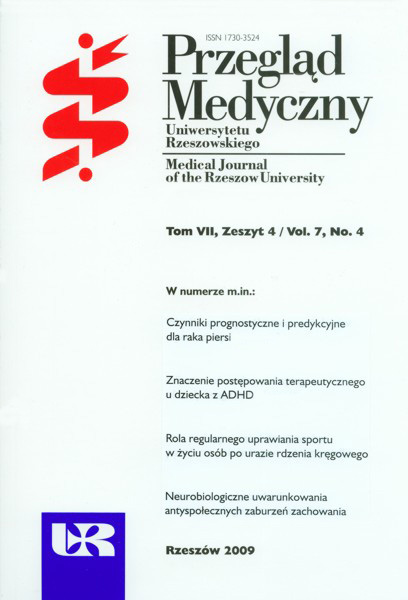
Factors related to prognosis and prediction of breast cancer
Keywords:
breast cancer, prognostic factors, molecular classificationAbstract
The progress in breast cancer therapy results from popularization of mammography screening and starting the treatment at the early stage of disease. Randomized trials involving adjuvant therapy proved the effectiveness of systemic treatment: hormonotherapy combined with chemotherapy. Introduction of systemic treatment improved survival of patients with breast cancer. The progress in the treatment requires the determination of factors that influence the response to the adjuvant therapy. In the case of breast cancer the prognostic factors and predictive factors are known. The conventional prognostic factors include: tumor burden, status of axillary lymph nodes, histological type of the tumor, grade of malignancy, presence of neoplastic cells in blood and lymph vessels. Prognostic factors allow to determine the course of the disease regardless of administered treatment. Important for the choice of the method of treatment and for prognosis are also predictive factors, that point to potential response to planned therapy. Predictive factors include estrogen receptors (ER), progesterone receptors (PgR) and HER2. The development of molecular biology enabled to utilize DNA microarrays in breast cancer research. The analysis of gene expression profiles unraveled two different subtypes of estrogen-dependent tumors: luminal A and luminal B, that differ with respect to gene expression signature and prognosis. In case of breast cancer with negative receptors also two subtypes exist: HER2 subtype and basal-like subtype. They differ with respect to the course of the disease and poor prognosis is observed.
Downloads
References
Krajowy Rejestr Nowotworów. Raporty na podstawie danych Centrum Onkologii. http://85.128.14.124/krn
Early Breast Cancer Trialists’ Collaborative Group: Effects of chemotherapy and hormonal therapy for early breast cancer on recurrence and 15-year survival: An overview of the randomized trials, Lancet 2005; 365:1687–1717.
Harris JR., Lippman ME., Veronesi U., Willett W. Breast Cancer 1. N Eng J Med 1992: 327:319–328.
Harris JR., Lippman ME., Veronesi U., Willett W. Breast Cancer 1. N Eng J Med 1992: 327:390–398.
Fitzgibbons PL., Page DL., Weaver D., Thor AD., Allred DC., Clark GM et al. Arch Pathol Lab Med. 2000; 124(7): 966–78.
Carter CL., Allen C., Henson DE. Relation of tumor size, lymph node status, and survival in 24,740 breast cancer cases, Cancer. 1989; 63(1):181–7.
Hammond ME., Fitzgibbons PL., Compton CC., Grignon DJ., Page DL., Fielding LP et al. College of American Pathologists Conference XXXV: solid tumor prognostic factors– which, how and so what? Summary document and recommendations for implementation, Cancer Committee and Conference Participants. Arch Pathol Lab Med. 2000;124(7):958–965.
Lee AH., Ellis IO., Pinder SE., Barbera D., Elston CW. Pathological assessment of sentinel lymph-node biopsies in patients with breast cancer, Virchows Arch. 2000;436(2): 97–101.
Hedley DW., Clark GM., Cornelisse CJ. , Killander D., Kute T., Merkel D., Consensus review of the clinical utility of DNA cytometry in carcinoma of the breast. Report of the DNA Cytometry Consensus Conference, Cytometry. 1993;14(5):482–5.
Paradiso A., Tommasi S., Mangia A., Lorusso V., Simone G., De Lena M., Tumor – proliferative activity, progesterone receptor status, estrogen receptor level, and clinical outcome of estrogen receptor-positive advanced breast cancer, Cancer Res. 1990;50 (10):2958–62.
Gasparini G., Barbareschi M., Doglioni C., Palma PD., Mauri FA., Boracchi P., et al. Exspression of bcl-2 protein predicts efficacy of adjuvant treatments in operable node-positive breast cancer. Clin Cancer Res. 1995; (2): 189–98.
Krajewski S., Blomqvist C., Franssila K., Krajewska M., Wasenius VM., Niskanen E., et al., Reduced expression of proapoptotic gene BAX is associated with poor response rates to combination chemotherapy and shorter survival in women with metastatic breast adenocarcinoma. Cancer Res. 1995;55(19):4471–8.
Foekens JA., Rio MC., Sequin S., Prediction of relapse and survival in breast cancer patients by protein status, Cancer Res. 1999;50:3832–3836.
Goldhirsch A., Wood WC., Senn HJ., Glick JH., Gelber RD., International consensus panel on the treatment of primary breast cancer, Eur J Cancer 1995; 31A; 1754–1759.
Ravdin PM., Green S., Mehn K., et al., Prognostic significance of progesteron receptor levels in estrogen receptor positive patients with metastatic breast cancer treated with tamoxifen a result of prospective Southwest Oncology Group Study. J Clin Oncol 1992; 10: 1284–1291.
Tamoxifen for early breast cancer: an overview of the randomised trials, Early Breast Cancer Trialists' Collaborative Group. Lancet 1998; 351(9114):1451–1467.
Slamon DJ., Clark GM., Wong SG., Levin WJ., Ullrich A., McGuire WL., Human breast cancer: correlation of relapse and survival with amplification of the HER2/neu oncogene, Science 1987;235: 177–182.
Goldhirsch A., Coates AS., Gelber RD., Glick JH., Thürlimann B., Senn HJ. St Gallen, Expert Panel Members. First-select the target: better choice of adjuvant treatments for breast cancer patients, Ann Oncol. 2006 Dec;17(12):1772–6.
Slamon DJ., Leyland-Jones B., Shak S., Fuchs H., Paton V., Bajamonde A., et al. Use of chemotherapy plus a monoclonal antibody against HER2 for metastatic breast cancer that overexpresses HER2. N Engl J Med. 2001; 344(11):783–92.
Baselga J., Herceptin alone or in combination with chemotherapy in the treatment of HER2-positive metastatic breast cancer: pivotal trials, Oncology 2001;61:14-21.
Marty M., Cognetti F., Maraninchi D., Snyder R., Mauriac L., Tubiana-Hulin M., et al. Randomized phase II trial of the efficacy and safety of trastuzumab combined with docetaxel in patients with human epidermal growth factor receptor 2-positive metastatic breast cancer administered as first-line treatment: the M77001 study group, J Clin Oncol. 2005;23(19):4265–74.
Romond EH., Perez EA., Bryant J., Suman VJ., Geyer CE Jr., Davidson NE., et al. Trastuzumab plus adjuvant chemotherapy for operable HER2-positive breast cancer, N Engl J Med 2005;353(16):1673–84.
Smith I., Procter M., Gelber RD., Guillaume S., Feyereislova A., Dowsett M., et al. HERA study team. 2-year follow-up of trastuzumab after adjuvant chemotherapy in HER2- positive breast cancer: a randomised controlled trial, Lancet. 2007; 369(9555): 29–36.
Sotiriou C., Neo SY., McShane LM., Korn EL., Long PM., Jazaeri A., et al. Breast cancer classification and prognosis based on gene expression profiles from a population based study, Proc Natl Acad Sci USA 2003; 100:10393–10398.
Sorlie T., Pereu CM., Tibshirani R., Aas T., Geisler S., Johnsen H., et al. Gene expression patterns of breast carcinomas distinguish tumor subclasses with clinical implications, Proc Natl Acad Sci USA 2001; 98: 10869–10874.
Carrey LA., Perou CM., Dressler LG., et al. Race and the poor prognosis basal-like breast cancer (BBC) phenotype in the population-based Carolina Breast Cancer Study. J Clin Oncol 2004 ( supp; abstr 9510).
Rouzier R., Anderson K., Hess KR., et al. Basal and luminal types of breast cancer defined by gene expression patterns respond differently to neoadjuvant chemotherapy. San Antonio Breast Cancer Symposium. San Antonio TX 2004 (abstr 1026).
Carrey LA. Dees EC., Sawyer L., et al. The triple negative paradox: Primary tumor chemosensitivity of the basal-like breast cancer (BBC) phenotype. San Antonio Breast Cancer Symposium. San Antonio TX 2004 (abstr 1023).
Miller KD., Burstein HJ., Elias A., et al. Phase II study of SU11248, a multitargeted receptor tyrosine kinase inhibitor (TKI), in patients with previously treated metastatic breast cancer (MBC). J Clin Oncol 2005 (suppl; abstr 563).
Nagata Y., Lan KH., Zhou X., Tan M., Esteva FJ., Sahin AA. et al. PTEN activation contributes to tumor inhibition by trastuzumab, and loss of PTEN predicts trastuzumab resistance in patients, Cancer Cell 2004; 6: 117–127.
Downloads
Published
How to Cite
Issue
Section
License
Copyright (c) 2009 Medical Journal of the Rzeszow University

This work is licensed under a Creative Commons Attribution 4.0 International License.
Our open access policy is in accordance with the Budapest Open Access Initiative (BOAI) definition: this means that articles have free availability on the public Internet, permitting any users to read, download, copy, distribute, print, search, or link to the full texts of these articles, crawl them for indexing, pass them as data to software, or use them for any other lawful purpose, without financial, legal, or technical barriers other than those inseparable from having access to the Internet itself.
All articles are published with free open access under the CC-BY Creative Commons attribution license (the current version is CC-BY, version 4.0). If you submit your paper for publication by the Eur J Clin Exp Med, you agree to have the CC-BY license applied to your work. Under this Open Access license, you, as the author, agree that anyone may download and read the paper for free. In addition, the article may be reused and quoted provided that the original published version is cited. This facilitates freedom in re-use and also ensures that Eur J Clin Exp Med content can be mined without barriers for the research needs.











