
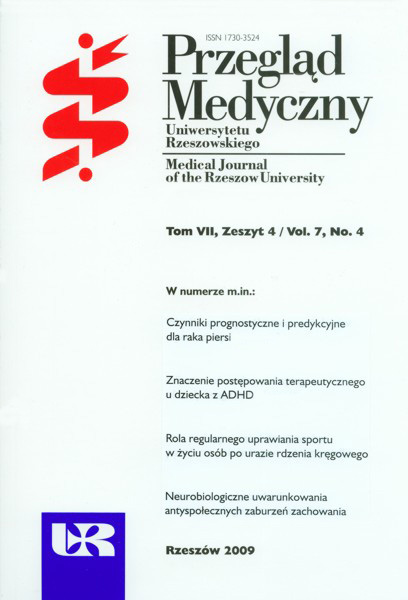
The role of a regular sport work out in the lives of people with spinal cord injury
Keywords:
spinal cord injury, disabled sports, physical activityAbstract
Introduction: The frequency of back injury with spinal cord injury is estimated at 25–35 people per 1 million population, of which 80–85% applies to men, while 61% of the cases concern people between 16 and 30. The purpose of rehabilitation of patients after spinal cord injury is preparation for independent living and the best possible performance of social roles. Active participation in the comprehensive rehabilitation creates conditions for the development of a disabled person. Sport is an important element of rationalization, allows to maintain physical fitness achieved during treatment in rehabilitation centers.
The aim: of this study was to know the motives of respondents that drive them to sport, to determine the benefits of practicing sports and to present plans for the future of respondents with disabilities.
Material and method: The research tool was a questionnaire consisting of 27 questions. Study group consisted of those who had a history of trauma to the spinal cord, in sport. The study involved 50 people, including 42 men and 8 women, aged from 20 to 40 years. Respondents practiced sport regularly.
Results: Motivations that induced subjects to engage in sports were as follows: continuation of rehabilitation, contact with the public, to overcome physical limitations, desire for active leisure, getting out from home. Persons with disabilities have claimed that sport influenced improvement to their well-being (96%) and acceleration of the acceptance of disability (82%). The surveyed declared their willingness to start a family, work, and achieve better professional positions.
Conclusions: Sport is an important element in the lives of people with reduced mobility. It is an important element of improvement in the rehabilitation process. It creates many benefits: a growing and supportive factor in good health triggers a hidden organism options, provide additional, strong motivation to perform the appropriate motor actions.
Downloads
References
Ptaszyńska-Sarosiek I., Niemcunowicz-Janica A., Janica J., Urazy kręgosłupa z uszkodzeniem rdzenia kręgowego – poglądy reprezentowane przez neurologów, Arch. Med. Sąd. Krym. 2007, LVII, 294–297.
Mraz M., Drab K., Rębalska M., Mraz M., Ocena stanu neurologicznego osób po urazie rdzenia kręgowego z wykorzystaniem klasyfikacji ASIA, Fizjoterapia 2000, 8, 2, 15– 18.
Vavra-Hadžiahmetović N., Quality of life of persons with spinal cord injury ten years experience, Folia Med 2009; 44, 1, 32–36.
Dega W., Koncepcja rehabilitacji, Probl. Rehab. Społ. Zaw. 1995, 1, 16.
Zygadło J., Polacy mistrzami świata, Med. Sport. 2003, 2, 80–81.
Walicka-Cupryś K., Bejer A., Domka-Jopek E., Dostrzegalne efekty długotrwałej pionizacji osób po urazie rdzenia kręgowego, Fizjoterapia 2007, 15, 3, 18–22.
Eng J. i in., Use of prolonged standing for individuals with spinal cord injuries, Phys. Ther, 2001, 81, 8, 1392–1399.
Kwolek A., Pop T., Tęcza T., Dobko M., Etiologia urazów kręgosłupa w odcinku szyjnym na podstawie danych Oddziału Neurochirurgii i Neurotraumatologii Szpitala Wojewódzkiego nr 2 w Rzeszowie, Fizjoterapia 2007, 15, 1, 32–39.
Barile A., Limbucci N., Splendiani A., Gallucci M., Masciocchi C., Spinal injury in sport, Eur J Radiol 2007, 62, 68–78.
Marques S., Garcez V., Del Bel E., Blanco Martinez A., A simple, inexpensive and easily reproducible model of spinal cord injury in mice: Morphological and functional assessment, J Neurosci Methods 2009, 177, 183–193.
Valent L., Dallmeijer A., Houdijk H., Talsma E., Woude E.: The effects of upper body exercise on the physical capacity of people with a spinal cord injury: a systematic review, Clin Rehabil 2007, 21, 315–330.
Siemianowicz A., Baron J., Wawrzynek W., Koczy B., Kasprowska B., Ocena zmian pourazowych kręgosłupa szyjnego na poziomie C1-C2 na podstawie tomografii komputerowej, Wiad Lek 2006, 59, 1–2, 48–51.
Liu H.: Spinal Cord Injury (SCI) Resources on the Internet, Health Care on the Internet 2000, 4, 1, 51–60.
Radek A., Maciejczak A., Zapałowicz K., Jóźwiak J., Urazy kręgosłupa z uszkodzeniem rdzenia kręgowego i korzeni ogona końskiego, Rehabil 1999, 3, 2, 94.
Suyama T., Kimura T., Yano H., Tobimatsu Y., Hatsuyama Y. i wsp., Rehabilitation of spinal cord injury in the national rehabilitation center for the disabled of Japan: profile of a spinal service, Spinal Cord 1997, 35, 720 –724.
Kamiński R., Koszykarze z Rzeszowa w podwójnej koronie, Sport Niepełnosprawnych 2007, 1, 24–26.
Kamiński R.: Taniec na wózkach, Sport Niepełnosprawnych 2007, 4, 12–16.
Tasiemski T., Bergstrom E., Savic G., Gardner B., Sports, recreation and employment following spinal cord injury- a pilot study, Spinal Cord 2000, 38, 173 – 184
Kennedy P., Taylor N., Hindson L., A pilot investigation of a psychosocial activity course for people with spinal cord injuries, Psychol Health Med 2006, 11, 1, 91 – 99
Slater D., Meade M., Participation in recreation and sports for persons with spinal cord injury: Review and recommendations, NeuroReh 2004, 19, 121–129.
Tasiemski T., Kennedy P., Gardner B., Taylor N., The association of sports and physical recreation with life satisfaction in a community sample of people with spinal cord injuries, NeuroReh 2005, 20, 253–265.
Sobiecka J., Wpływ uprawiania dyscyplin sportu paraolimpijskiego na samopoczucie i stan zdrowia osób niepełnosprawnych (na przykładzie zawodników z Węgier i Polski), Ann UMCS Sect D 2003, LVIII, XIII, 229.
Bolach E.: Motywacja zawodników pełnosprawnych i niepełnosprawnych uprawiających sportowo piłkę siatkową, Fizjoterapia 1999, 7, 2, 43–49.
Harris C., Hills M., Why we do what we do: Disability sport perspectives from the pacific, JSSM 2006, 9, 28–29.
Urban R, Geneza i rozwój sportu jeździeckiego osób niepełnosprawnych w Polsce [w:] Społeczno-edukacyjne oblicza olimpizmu, Ruch olimpijski i niepełnosprawni sportowcy II, Chełmecki J., PZWL, Warszawa 2006.
Sobiecka J., Styl życia osób niepełnosprawnych uprawiających sport paraolimpijski (na przykładzie zawodników z Węgier i Polski), Ann UMCS Sect D 2003, LVIII, XIII, 228.
Bouisset S., Sport and handicap, Science & Sports 2006, 21, 219–220.
Plinta R., Saulicz E., Sobiecka J., Knapik A., Saulicz M.: Szybkość reakcji osób niepełnosprawnych aktywnych i nieaktywnych fizycznie, Ann UMCS Sect D 2005, LX, XVI, 419.
Plinta R., Saulicz E., Sobiecka J., Knapik A., Myśliwiec A.: Uprawianie sportu na wózkach jako czynnik poprawiający zdolności lokomocyjne osób niepełnosprawnych, Ann UMCS Sect D 2005, LX, XVI, 420.
Sobiecka J., Środowisko osób inspirujących niepełnosprawnych do podjęcia aktywności sportowej, Post Rehab 2007, 1.
Downloads
Published
How to Cite
Issue
Section
License
Copyright (c) 2009 Medical Journal of the Rzeszow University

This work is licensed under a Creative Commons Attribution 4.0 International License.
Our open access policy is in accordance with the Budapest Open Access Initiative (BOAI) definition: this means that articles have free availability on the public Internet, permitting any users to read, download, copy, distribute, print, search, or link to the full texts of these articles, crawl them for indexing, pass them as data to software, or use them for any other lawful purpose, without financial, legal, or technical barriers other than those inseparable from having access to the Internet itself.
All articles are published with free open access under the CC-BY Creative Commons attribution license (the current version is CC-BY, version 4.0). If you submit your paper for publication by the Eur J Clin Exp Med, you agree to have the CC-BY license applied to your work. Under this Open Access license, you, as the author, agree that anyone may download and read the paper for free. In addition, the article may be reused and quoted provided that the original published version is cited. This facilitates freedom in re-use and also ensures that Eur J Clin Exp Med content can be mined without barriers for the research needs.











