
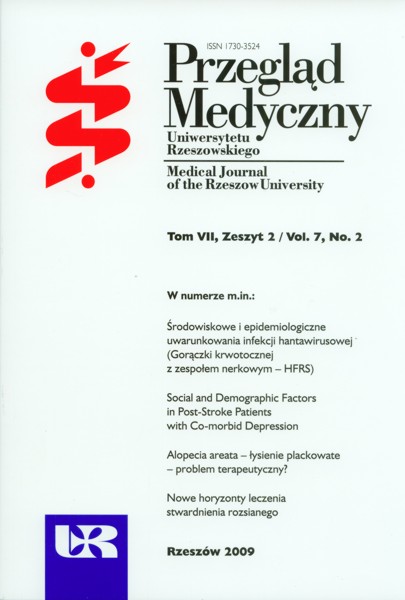
Environmental and epidemiologic determinants of hantavirus infection (hemorrhagic fever with renal syndrome) in the Podkarpacie – first epidemic in Poland in 2007-2008 – and endemic incidences of diseases
Keywords:
hantavirus diseases (HVD), Dobrava virus (DOBV), Puumala virus (PUUV), “emerging zoonotic diseases”, the occurrence in Rzeszowszczyzna region in the southeast PolandAbstract
These researches presented epidemiological and environmental conditions of cases of haemorrhagic fever with renal syndrome (HFRS) — a zoonoses caused by hantaviruses which were found for the first time in Poland in 2004 in the Sub Carpathian (voivodhship) and an epidemic of which occurred in 2007. Virological diagnostics and clinical courses of diseases, prophylactic and educational actions taken in the area and their effectiveness were discussed.
Downloads
References
Knap J.P., Trybusz A.: Artykuł Redakcyjny. Gorączka krwotoczna z zespołem nerkowym – zakażenie Hantawirusem występujące w Polsce, Pol. Merk. Lek. 2006, XXI, 125, 411–417.
Knap J.P., Brzostek T., Rączka A., Burzyński W., Litarska U.: Przypadek gorączki krwotocznej z zespołem nerkowym (HFRS), Pol. Merk. Lek. 2006, XXI, 125, 474–476.
Główny Inspektorat Sanitarny. Stan sanitarny kraju w roku 2005. GIS, Warszawa 2006,1–104.
Burzyński W., Witas M., Nowakowska A.: Podejrzenie pięciu przypadków zespołu nerkowego wywołanego hantawirusem w woj. podkarpackim, Meldunek Epidemiologiczny GIS/PZH 11/A 07, 6.
Knap J.P.: Gorączka Krwotoczna z Zespołem Nerkowym (HFRS) – „nowe” zagrożenie zdrowia publicznego w Polsce, Postępy Higieny i Epidemiol. 2008, 89, supl. 1,3–4.
Nowakowska A., Heyman P., Knap J.P., Burzyński W., Witas M.: The first epidemic focus on Hantavirus infections in Poland, 2007. Ann. Agricult.Environm. Med. 2009, 16, 1,79–85.
Mailles A., Abu Sin M., Ducoffre G., Heyman P., Koch J.: Largel than usual increase in cases of hantavirus in Belgium, France and Germany, June 2005. Eurosurveillance. 2005, 10, 7–9, 198–200.
Heyman P., Cochez C., Ducoffre G., Mailles A., Zeller H., Abu Sim M.: Haemorrhagic Fever with Renal Syndrome: an analysis of the outbreaks in Belgium, France, Germany, The Netherlands and Luxembourg in 2005. Eurosurveillance. 2007, 12, 3–6, 167–171.
Falldefinitionen des Robert Koch-Instituts zur Ubermittlungen von Erkrankungs – oder Todesfallen und Nachweisen von Krankheitserregern – Ausgabe 2007, 20, Hantavirus (Hantavirus-Erkrankung – virales hamorrhagisches Fieber). Robert Koch Institut. Berlin 2007, 64–65.
Biel S.S., Donoso M.O., Lemmer K., Vaheri A., Lundkvist A., Emmerich P. i wsp.: Quality control measures for the serological diagnosis of hantavirus infections, J. Clin. Virol. 2003, 28, 248–256.
Litarska U., Knap J.P., Zięba J.: Pracownia leptospiroz WSSE we Wrocławiu (1947–2005). Uwagi na tle jej działalności, Przegl. Epid. 2006, 60, 213–224.
WHO. Human leptospirosis: guidance for diagnosis, surveillance and control, WHO/ILS. Geneva, 2002, 1–110.
Crowcroft N.S., Infuso A., Illef D., LeGuenno B., Desenclos J.-C., Van Loock F., Clement J.: Risk factors for human hantavirus infection: Franco-Belgium collaborative case-control study during 1995–96 epidemic, Brit. J. Med. 1999, 318, 1737–1738.
Hjelle B., Jenison S., Torrez-Martinez N., Herring B., Quan S., Polito A. i wsp..: Rapid and specific detection of Sin Nombre virus antibodies in patients with Hantaan Pulmonary Syndrome by a Strip Immunoblot Assay suitable for field diagnosis, J. Clin. Microbiol. 1997, 35, 3, 600–608.
Schilling S., Emmerich P., Klempa B., Auste B., Schnaith E., Schmitz H. i wsp.: Hantavirus disease outbreak in Germany: limitations of routine serological diagnostic and clustering of virus sequences of human and rodent origin, J. Clin. Microbiol. 2007,45,9,3008–3014.
Nowakowska A.: Zakażenia hantawirusowe (HFRS, NE). Ankieta wypełniana przez lekarza na podstawie wywiadu/historii choroby – uzupełniana przez prowadzącego zbieranie informacji, WSSE Rzeszów, 2008.
Kondracki J.: Geografia Polski. Mezoregiony fizycznogeograficzne, PWN. Warszawa 1994.
Richling A. (red.): Geograficzne badania środowiska przyrodniczego, PWN. Warszawa 2007.
Gregg M. (ed.): Field Epidemiology, Oxford University Press. USA. 3 wydanie. 2008.
Ryszkowski L. (ed.): Landscape ecology in agroecosystems management. CRC Press, Boca Raton. London, New York, Washington D.C. 2002, 1–366.
Pucek Z., Jędrzejewski W., Jędrzejewska B., Pucek M.: Rodent population dynamics in primeval deciduous forest (Białowieża National Park) in relation to weather, seed crop and predation, Acta theriologica. 1993, 38, 199–232.
Dubinsky P., Malczewski A., Miterpakova M., Gawron J., Reiterova K.: Echinococcus multilocularis in the red fox Vulpes vulpes from the East Carpathian region of Poland and the Slovak Republic, J. Helminthology. 2006, 80, 243–247.
Gresikova M. (red.): Hemoragicka horucka s renalnym syndromom, Veda. Bratislava, 1988, 1–128.
Wojewoda K.: Leśne Podkarpacie. 30 lat Regionalnej Dyrekcji Lasów Państwowych w Krośnie, RS DRUK. Rzeszów 1–286.
Plank I., Reżucha M., Rojković D.: Prve dva diagnostikovane pripady hemoragickej nefroso-nefritidy na uzemi naśej republiky, Ćas. Lek. Ćeskych (Praha). 1955, 94, 1078–1084.
Górecki A., Ćwikowski C., Gryc A., Jabłońska I.: Drobne ssaki Bieszczadów, Monografie Biesczadzkie. 2000. Tom 9, 71–90.
Czerniawska-Ankiersztein M., Lejbrandt E., Płońska E., Krszyna J.: Badania pracowników Kampinoskiego Parku Narodowego w kierunku zakażenia hantawirusem serotyp Puumala. Dwutygodniowy Meldunek Epidemiologiczny, Główny Inspektorat Sanitarny/Państwowy Zakład Higieny-Narodowy Instytut Zdrowia Publicznego. 2007,No. 12/A/07.
Bojańczyk J.: Uroczy weekend na wsi, Rzeczpospolita. 4 maja 2008,103 (8004).
Cvetko L., Turk N., Markotic’ A., Milas Z., Margaletic’ J., Miletic’-Medved M. i wsp.: Short report: dual infections with Puumala virus and Leptospira interrogans serovar Lora in a bank vole (Clethrionomys glareolus). Am. Trop. Med. Hyg. 2006, 74, 4, 612–614.
Stanko M., Mosansky L., Fricova J., Schniererova E., Cislakova L.: Long-term survey of natural focus in the East Slovakia. Proceedings of the International Conference: Zoonoses, their Agents and Vectors. 4–6 April 2005. Smolenice, Slovakia, 27 pp.
Sibold C., Meisel H., Lundkvist A., Schulz A., Cifire C., Ulrich R. i wsp.: Simultaneous occurrence of Dobrava, Puumala and Tula Hantaviruses in Slovakia, Am. J. Trop. Med. Hyg. 1999, 61, 409–411.
Klempa B.: Dobrava and Tula hantaviruses from Central Europe: molecular evolution and pathogenic relevance. Dissertation (DR rer. Nat.) Humboldt Universitat. Berlin 2004.
Sibold C., Ulrich, Labuda M., Lundkvist A., Martens H., Schutt M. i wsp.: Dobrava hantavirus causes hemorrhagic fever with renal syndrome in Central Europe and is carried by two different Apodemus mice species, J. Med. Virol. 2001, 63, 158–167.
Clement J., Vercauteren J., Verstraeten W.., Ducoffre G., Barrios J.M., Vandamme A-M. i wsp.: Relating increasing hantavirus incidences to the changing climate: the mast connection. Intern. J. Health Geographics. 2008, 8, 1; http://www.pubmedcentral.nih.gov.
Knap J.P., Rączka A., Dutko S., Litarska U., Klich K., Grabowski M.L. i wsp.: Badania wstępne nad występowaniem i kliniką gorączki krwotocznej z zespołem nerkowym (HFRS) w Polsce. „Zoonozy”. Materiały Sympozium PTM/PTMW. Warszawa 2006, 61.
Parnas J., Mazurek Z., Szmunes W., Koślak A., Umiński J., Zwolski W. i wsp.: Forschungen uber Krankheitsherde der Anthropozoonoses im Bieszczady-Gebiet (Karpaten). Archiv fur Veterinarmedizin. 1962, XVI, 6, 1091–1099.
Petterson L., Kingstrom J., Hardestam J., Lundkvist A., Ahim C., Evander M.: Hantavirus RNA in saliva from patients with hemorrhagic fever with renal syndrome. Emerg. Infect. Dis. 2008, 14, 3, 406–411.
Downloads
Published
How to Cite
Issue
Section
License
Copyright (c) 2009 Medical Journal of the Rzeszow University

This work is licensed under a Creative Commons Attribution 4.0 International License.
Our open access policy is in accordance with the Budapest Open Access Initiative (BOAI) definition: this means that articles have free availability on the public Internet, permitting any users to read, download, copy, distribute, print, search, or link to the full texts of these articles, crawl them for indexing, pass them as data to software, or use them for any other lawful purpose, without financial, legal, or technical barriers other than those inseparable from having access to the Internet itself.
All articles are published with free open access under the CC-BY Creative Commons attribution license (the current version is CC-BY, version 4.0). If you submit your paper for publication by the Eur J Clin Exp Med, you agree to have the CC-BY license applied to your work. Under this Open Access license, you, as the author, agree that anyone may download and read the paper for free. In addition, the article may be reused and quoted provided that the original published version is cited. This facilitates freedom in re-use and also ensures that Eur J Clin Exp Med content can be mined without barriers for the research needs.











