
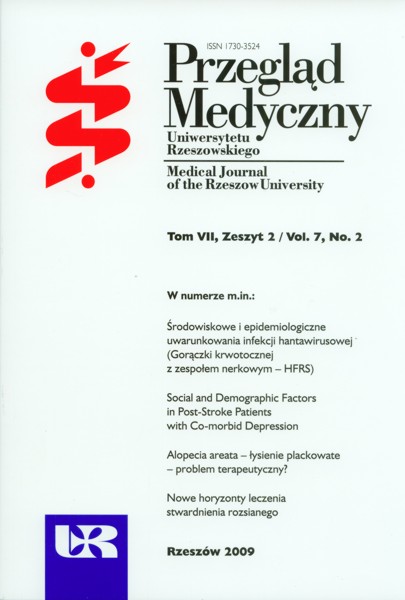
Alopecia areata – a therapeutic problem?
Keywords:
alopecia areata, baldness, review, therapeutic problemAbstract
Alopecia areata is a disease affecting the whole population. The main symptoms are regions of baldness on the head, it also sometimes affects other hairbearing areas of the skin. The etiology is considered to be autoimmunologic cause. There are few clinical variants of alopecia areata. Diagnosis mainly is made on clinical features, sometimes biopsy is helpful. The process of alopecia development and hair —regrowth is unpredictable. In differential diagnosis there are considered head dermatoses and systemic diseases. The presence of alopecia areata predisposes to manifestation of coexisting autoimmunologic diseases. Treatment is difficult, long-lasting and sometimes it does not show expected results. There are four groups of medicine to administer. They stimulate hair-regrowth, but do not prevent hair loss.
Downloads
References
Dombrowski NC, Bergfeld WF.: Alopecia areata: what to expect from current treatments, Cleve Clin J Med. 2005 Sep;72(9):758, 760–1, 765–6, passim.
Papadopoulus AJ, Schwartz RA, Krysicka Janniger C. Alopecia areata: emerging concepts, Acta Dermatovenerologica 2000 Vol 9, No 3.
Jabłońska S., Chorzelski T.: Choroby skóry wydanie V, PZWL, Rozdział: Łysienie plackowate.
Sahn EE; Alopecia areata in childhood, Semin Dermatol. 1995 Mar;14(1):9–14.
Schwartz RA, Janniger CK.: Cutis. Alopecia areata 1997 May; 59(5): 238–41.
Papadopoulos AJ, Schwartz RA, Janniger CK.: Alopecia areata. Pathogenesis, diagnosis, and therapy Am J Clin Dermatol. 2000 Mar-Apr; 1(2):101–5.
Fiedler VC. Alopecia areata. A review of therapy, efficacy, safety, and mechanism. Arch Dermatol. 1992 Nov; 128(11):1519–29.
Grandolfo M, Biscazzi AM, Pipoli M.: AA and autoimmunity. G Ital Dermatol Venereol. 2008 Oct; 143( 5): 277–81.
Cetin ED, Savk E, Uslu M, Eskin M, Karul A.: Investigation of the inflammatory mechanisms in alopecia areata. Am J Dermatopathol. 2009 Feb;31(1):53–60.
Abdel-Hafez HZ, Mahran AM, Hofny ER, Attallah DA, Sayed DS, Rashed HA.: Is Helicobacter pylori infection associated with alopecia areata? J Cosmet Dermatol. 2009 Mar;8(1):52–5.
Du Vivier A, Munro DD.: Alopecia areata, autoimmunity, and Down's syndrome. Br Med J. 1975 Jan 25; 1(5951):191–2.
Mysliborski J, Rappaport IP, Rouleau GA, Carlson JA.: Alopecia areata universalis in an infant. LaRow JA J Cutan Med Surg. 2001 Mar-Apr;5(2):131–4. Epub 2001 Feb 7.
Chen W.: Alopecia areata universalis sparing nevus flammeus. Dermatology. 2005;210(3):227–8.
Hawit F, Silverberg NB.: Alopecia areata in children., Cutis. 2008 Aug;82(2):104–10.
Freyschmidt-Paul P, Hoffmann R, Levine E, Sundberg JP, Happle R, McElwee KJ.: Current and potential agents for the treatment of alopecia areata, Curr Pharm Des. 2001 Feb;7(3):213–30.
Freyschmidt-Paul P, Happle R, McElwee KJ, Hoffmann R.: Alopecia areata: treatment of today and tomorrow, J Investig Dermatol Symp Proc. 2003 Jun;8 (1):12–7.
Alabdulkareem AS, Abahussein AA, Okoro A.: Severe alopecia areata treated with systemic corticosteroids, Int J Dermatol. 1998 Aug;37(8):622–4.
Broniarczyk-Dyla G, Wawrzycka-Kaflik A, Dubla-Berner M, Prusinska-Bratos M. Effects of psoralen-UV-A-Turban in alopecia areata, Skinmed. 2006 Mar-Apr; 5(2):64–8.
Behrens-Williams SC, Leiter U, Schiener R, Weidmann M, Peter RU, Kerscher M.: The PUVA-turban as a new option of applying a dilute psoralen solution selectively to the scalp of patients with alopecia areata, J Am Acad Dermatol. 2001 Feb;44(2):248–52.
Fiedler VC, Alaiti S.: Treatment of alopecia areata. Dermatol Clin.996 Ot;14(4):733–7.
Delamere FM, Sladden MM, Dobbins HM, Leonardi-Bee J.: Interventions for alopecia areata, Cochrane Database Syst Rev. 2008 Apr 16;(2):CD004413.
DeVillez RL.: The therapeutic use of topical minoxidil. Dermatol Clin. 1990 Apr;8(2):367–75.
Trüeb RM, Cavegn B.: Trichotillomania in connection with alopecia areata, Cutis. 1996 Jul;58(1):67–70.
Nigel Hunt, Sue McHale. Clinical review The psychological impact of alopecia. MJ 2005; 331: 951 953 (22 October)
Prockitt J, McMichael AJ, Gallager L, Klabokes V, Boeck C.: Helping patients cope with chronic alopecia areata, Dermatol Nursing 2004;16: 237–241.
Shapiro S, Madani J.: Alopecia areata: diagnosis and management, Int J dermatol 1999; 38: 19–24.
Horodinsky M, Ericson M.: Autoimmunity: alopecia areata. J Invest Dermatol Symp Proc 2004; 9: 73–78.
Freyschmidt-Paul P, Happle R, McElwee KJ, Hoffman R.: Alopecia areata: treatment of today and tomorrow, J Invest Dermatol Symp Proc 2003; 8: 12–17
Gundogan C, Greve B, Raulin C.: Treatment of alopecia areata with the 308-nm xenon chloride excimer laser: case report of two successful treatments with the excimer laser, Laser Surg Med 2004; 34: 86–90.
Downloads
Published
How to Cite
Issue
Section
License
Copyright (c) 2009 Medical Journal of the Rzeszow University

This work is licensed under a Creative Commons Attribution 4.0 International License.
Our open access policy is in accordance with the Budapest Open Access Initiative (BOAI) definition: this means that articles have free availability on the public Internet, permitting any users to read, download, copy, distribute, print, search, or link to the full texts of these articles, crawl them for indexing, pass them as data to software, or use them for any other lawful purpose, without financial, legal, or technical barriers other than those inseparable from having access to the Internet itself.
All articles are published with free open access under the CC-BY Creative Commons attribution license (the current version is CC-BY, version 4.0). If you submit your paper for publication by the Eur J Clin Exp Med, you agree to have the CC-BY license applied to your work. Under this Open Access license, you, as the author, agree that anyone may download and read the paper for free. In addition, the article may be reused and quoted provided that the original published version is cited. This facilitates freedom in re-use and also ensures that Eur J Clin Exp Med content can be mined without barriers for the research needs.











