
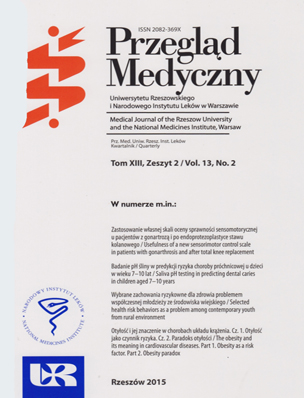
The obesity and its meaning in cardiovascular diseases Part 1. Obesity as a risk factor
DOI:
https://doi.org/10.15584/przmed.2015.2.9Keywords:
obesity, metabolic obesity with normal weight, cardiovascular disease, body mass index, sick fat, obesity paradoxAbstract
Obesity is an excessive accumulation of fat in adipose tissue due to genetic background and environmental conditions. According to WHO it can be identifid with BMI > 30 kg/m². It is a chronic disease, with global range, an epidemic of XXI age. It is a well-known risk factor of many cardiovascular (CV) diseases, coronary artery disease (CAD), myocardial infarction (MI), heart failure (HF), stroke, metabolic disorders (diabetes, metabolic syndrome, dyslipidemia) and a cause of permanent disability or premature death. There are 3 types of obesity: metabolic obese with normal weight (MONW), androgenic (an apple) and gynoic (a pear) obesity. Each one is a consequence of imbalance between energy supply and its combustion and usually has a genetical background, but has a diffrent course. MONW can lead (if not stopped by a proper diet and physical activity) to CV and metabolic disorders, the pear type predisposes to joint degeneration, while an apple type is related to cardiac diseases such as MI, stroke, hypertension (HT). Adipose tissue is an endocrine organ producing many hormones and mediators. „Sick fat“ or adiposopathia is a pathologic state due to chronic inflmmatory process taking place in adipose tissue, leading to obesity and its pathologic consequences. The obese patients more often and earlier suffr from HT, CAD, MI, HF, rhythm disorders and even sudden cardiac death (SCD). Obesity leads to insulin resistance, dyslipidemia, metabolic syndrome, and fially to diabetes mellitus t. 2 (DM t.2). This article is a short review of obesity and its role in cardiovascular diseases.
Downloads
Downloads
Published
How to Cite
Issue
Section
License
Copyright (c) 2015 Medical Journal of the Rzeszow University and the National Medicines Institute, Warsaw

This work is licensed under a Creative Commons Attribution 4.0 International License.
Our open access policy is in accordance with the Budapest Open Access Initiative (BOAI) definition: this means that articles have free availability on the public Internet, permitting any users to read, download, copy, distribute, print, search, or link to the full texts of these articles, crawl them for indexing, pass them as data to software, or use them for any other lawful purpose, without financial, legal, or technical barriers other than those inseparable from having access to the Internet itself.
All articles are published with free open access under the CC-BY Creative Commons attribution license (the current version is CC-BY, version 4.0). If you submit your paper for publication by the Eur J Clin Exp Med, you agree to have the CC-BY license applied to your work. Under this Open Access license, you, as the author, agree that anyone may download and read the paper for free. In addition, the article may be reused and quoted provided that the original published version is cited. This facilitates freedom in re-use and also ensures that Eur J Clin Exp Med content can be mined without barriers for the research needs.











