
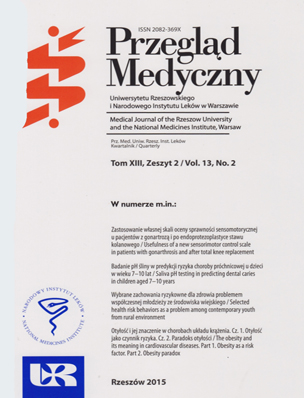
The obesity and its meaning in cardiovascular diseases Part 2. Obesity paradox
DOI:
https://doi.org/10.15584/przmed.2015.2.10Keywords:
obesity paradox, overweight, cardiac failure, hypertensionAbstract
There are many papers on the different influence of obesity and overweight on appearance and prognosis of circulatory system diseases. In previous part we tried to present the obesity and its pathogenic influence on the formation of circulatory system diseases i.e. the obesity as a risk factor. In the second part we present the data on better prognosis in patients with advanced circulatory diseases. This is called the obesity paradox. It refers to HT, CAD, MF, HF. It seems to be protective and brings advantages in the course of disease. Fat tissue can be a source of energy in advanced diseases which cause a stress reaction. This creates the energy demands, the fulfil of which is impossible by the lack of reserves. It is confirmed by clinical observations. The highest mortality rate is observed in patients with underweight and extreme obesity (BMI > 35), and the lowest in group with normal weight and mild obesity. So, the obesity paradox means better prognosis for patients with obesity and overweight with CV diseases. The best explanation of this phenomenon is an HF example, where in the situation of negative energetic balance (underweight) during the aggravation of illness („inflammation“) the exhaust of resources takes place. It means superiority of catabolism processes and leads progressively to cachexia and death. On the other hand, where there is an excess of resources (overweight, obesity) it can be used, consumed and the exacerbation of HF is milder. The overweight paradox among the healthy ones means better prognosis for longer life.
Downloads
References
World Health Organization. The challenge of obesity in the WHO European Region. Fact sheet EURO 2005; 13/5: 1-6.
Sharma AM. The value of current interventions for obesity. Cardiovasc Med 2008; 5: 3-8. doi: 10.1038/ncpcardio0854
Habbu A, Lakkis NM, Dokainish H.The obesity paradox: Fact or Fiction? Am J Cardiol 2006; 98 (7): 944-948. doi: 10.1016/j.amjcard.2006.04.039
Bucyk B, Tupikowska M, Bednarek-Tupikowska G. Kryteria rozpoznania zespołu metabolicznej otyłości z prawidłową masą ciała (MONW). Endokrynologia, Otyłość i Zaburzenia Przemiany Materii 2009; 5 (4): 226–232.
Widecka K, Grodzicki T, Narkiewicz K, Tykarski A, Dziwura J. Zasady postępowania w nadciśnieniu tętniczym – 2011r. Wytyczne Polskiego Towarzystwa Nadciśnienia Tętniczego.
Nadciśnienie tętnicze 2011; 15 (2): 56-82.
Bednarek-Tupikowska G, Matczak-Giemza M, Kubicka E, Krzyżanowska-Świniarska B. Metaboliczna otyłość u osób z prawidłową masą ciała. Endokrynologia, Otyłość i Zaburzenia Przemiany Materii 2007; 3 (3): 55–61.
Hammersen F. Histologia. Wydawnictwo Urban &Partner. Wrocław 1993; 65-72.
Malinowski M, Deja M, Gołba K, Januszewicz P, Roleder T, Woś S. Wpływ okołonaczyniowej tkanki tłuszczowej na funkcje naczyń. Kard Pol 2008; 10: 317-329.
Eckel RH. Obesity and Heart Disease. Circulation 1997; 96: 3248-3250.
Myrda K, Rozentryt P, Nowak J, Niedziela J, Kawecka E, Poloński L. Tkanka tłuszczowa w niewydolności serca - wróg czy przyjaciel? Folia Cardiologica Excerpta 2010; 5 (4): 232–241.
Chen P, Park C, Karrar E, Wang C, Liao J. ROCK2 Mediates Browning of White Fat and Protects Against Obesity. Circulation 2014; 130: A19727.
Małecka-Tendera E, Mazur A. Definicja otyłości. W: Małecka-Tendera E, Socha P. (red.). Otyłość u dzieci i młodzieży. Wydawnictwo Lekarskie PZWL, Warszawa 2011; 9-12.
Falcao-Pires I, Castro-Chaves P, Miranda-Silva D. Physiological, pathological and potential therapeutic roles of adipokines. Drug Discovery Today 2012; 17: 880-889. doi: 10.1016/j.drudis.2012.04.007
Nguyen T, Lau D. The obesity epidemic and its impact on hypertension. Can J Cardiol 2012; 28: 326-333. doi: 10.1016/j.cjca.2012.01.001
Lavie CJ, Milani RV, Ventura HO. Obesity and cardiovascular disease. J Am Coll Cardiol 2009; 53: 1925-1932. doi: 10.1016/j.jacc.2008.12.068
Sędkowska A, Gawron- Kiszka M, Tomaszewski M, Kowalczyk J, Streb W, Markowicz-Pawlus E, Obrębska J, Kalarus Z, Żukowska-Szczechowska E. Otyłość i cukrzyca t. 2 a przerost lewej komory serca u pacjentów z nadciśnieniem tętniczym. Nadciśnienie Tętnicze 2011; 15: 93-101.
Fonarow G, Srikanthan P, Costanzo M. An obesity paradox in acute heart failure: Analysis of body mass index and inhospital mortality for 108 927 patients in the Acute Decompensated Heart Failure National Registry. J Am Heart Fail 2007; 153: 74-81. doi: 10.1016/j.ahj.2006.09.007
Andreotti F, Rio T, Lavorga A. Body fat and cardiovascular risk: understanding the obesity paradox. Eur Heart J 2009; 30: 752-754. doi: 10.1093/eurheartj/ehp081
Yusuf S, Hawken S. Obesity and risk of myocardial infarction in 27 000 participants from 52 countries: a case-control study. Lancet 2005; 366: 1640-1649. doi: 10.1016/S0140-6736(05)67663-5
Dziwura-Ogonowska J, Heryć R, Mierska K, Modrzejewska A, Miazgowski T, Widecka K. Jak oceniać otyłość brzuszną u pacjentów z pierwotnym nadciśnieniem tętniczym? Nadciśnienie Tętnicze 2012; 16: 28-33.
Evangelista L, Moser D, Westlake C, Hamilton M, Fonarow GC, Dracup K. Impact of obesity on quality of life and depression in patients with heart failure. Eur J Heart Fail 2006; 8 (7): 750-755. doi: 10.1016/j.ejheart.2006.02.004
Czech A, Bernas M, Tatoń J. Sercowo-naczyniowe objawy otyłości. Endokrynologia, Otyłość i Zaburzenia Przemiany Materii 2007; 3: 85-89.
Tsang T, Barnes M, Miyasaka, Cha S. Obesity as a risk factor for the progression of paroxysmal to permanent atrial fibrillation: a longitudinal cohort study of 21 years. Eur Heart J 2008; 29: 2227-2233. doi: 10.1093/eurheartj/ehn324
Tedrow UB. The long- and short-term impact of elevated body mass index on the risk of new atrial fibrillation: the WHS (Women`s Health Study). J Am Coll Cardiol 2010; 55: 2319-2327. doi: 10.1016/j.jacc.2010.02.029
Arora R, Knight BP. Epicardial atrial FAT. Not quite as idle as it looks. Heart Rhythm 2015; 12(2): 266-267. doi: 10.1016/j.hrthm2014.10.040
Bogołowska-Stieblich A, Tałaj M. Otyłość a choroby układu sercowo-naczyniowego. Postępy Nauk Medycznych 5b/2013; 19-25.
Kurth T, Gaziano M, Berger K. Body Mass Index and The Risk of Stroke in Men. JAMA 2002; 162: 2557-2562. doi: 10.1001/archinte.162.22.2557
Poirier P, Giles TD, Bray GA, Hong Y, Stern JS. Pi-Sunyer FX, Eckel RH. Obesity and cardiovascular Disease. Circulation 2006; 113: 898-918.
Cybulska B, Kłosiewicz- Latoszek L. Co znaczy paradoks otyłości w chorobie wieńcowej? Kard Pol 2013; 71: 963-968.
Andreotti F, Rio T, Lavorgna A. Body fat and cardiovascular risk: uderstanding the obesity paradox. Eur Heart J 2008; 30: 752-754. doi: 10.1093/eurheartj/ehp081
Angeras O, Albertsson P, Karason K, Romunddal T, Matejka G, James S, Lagerqvist B, Rosengren A, Omerovic E. Evidence for obesity paradox in patients with acute coronary syndromes: a report from the Swedish Angiography and Angioplasty Registry. Eur Heart J 2013; 34(5): 345-353. doi: 10.1093/eurheartj/ehs217
Nikolsky E, Stone G, Grines C, Cox D. Impact of body mass index on outcomes after primary angioplasty in acute myocardial infarction. Am Heart J 2006; 151: 168-175. doi: 10.1016/j.ahj.2005.03.024
Barba R, Bisbe J, Pedrajas JNA, Toril J, Monte R, Munoz-Torrero JFS, Monreal M. Body mass index and outcome in patients with coronary, cerebrovascular, or peripheral artery disease: Findings from the FRENA registry. Eur J Cardiovasc Prev Rehabil 2009; 16(4): 457-463. doi: 10.1097/HJR.0b013e32832b1818
Diercks DB, Roe MT, Mulgund J, Pollack CV Jr, Kirk JD, Gibler WB, Ohman EM, Smith SC Jr, Boden WE, Peterson ED. The obesity paradox in non-ST-segment elevation acute coronary syndromes: Results from the Can Rapid risk stratification of Unstable angina patients Suppress Adverse outcomes with Early implementation of the American College of cardiology / American Heart Association guidelines Quality / Improvement Initiative. Am Heart J 2006; 152: 140-148. doi: 10.1016/j.ahj.2005.09.024
Wagner BD, Grunwald GK, Rumsfeld JS, Hill JO, Ho MP, Wyatt HR, Shroyer LW. Relationship of Body Mass Index with Outcomes After Coronary Artery Bypass Graft Surgery. The Ann Thor Surg 2007; 84 (1): 10-16. doi: 10.1016/j.athoracsur.2007.03.017
Kennedy M, Dickstein K, Anker S, Kristianson K, Willenheimer R. The prognostic importance of body mass index after complicated myocardial infarct. J Am Coll Cardiol 2005; 45: 154-164.
Zeller M, Gabriel P, Ravisy J, Lorgis L. Relation between body mass index, waist circumference, and death after acute myocardial infarction. Circulation 2008; 118: 482-490. doi: 10.1161/CIRCULATIONAHA.107.753483
Oreopoulos A, McAlister FA, Kalantar-Zadeh K, Padwal R, Ezekowitz JA, Sharma AM, Kowesdy CP, Fonarow GC, Noris CM. The relationship between body mass index, treatment, and mortality in patients with established coronary artery disease: a report from APPROACH. Eur Heart J 2009;
(21): 2584-2592. doi: 10.1093/eurheartj/ehp288
Sarno G, Raber L, Onuma Y, Garg S, Brugaletta S, Domburg R. Impact of Body mass Index on the Five - Year Outcome of Patients Having Percutaneous Coronary Interventions With Drug-Eluting Stents. Am J Cardiol 2011; 108: 195-201. doi: 10.1016/j.amjcard.2011.03.023
Doehner W, Clark A, Anker S. The obesity paradox: weighing the benefit. Eur Heart J 2010; 31: 146-148. doi: 10.1093/eurheartj/ehp339
Clark A, Chyum J, Horwich T. The Obesity Paradox in Men versus Women With Systolic Heart Failure. Am J Cardiol 2012; 110: 77-82. doi: 10.1016/j.amjcard.2012.02.050
Anker S, Negassa A, Coats A. Prognostic importance of weight loss in chronic heart failure and the effect of treatment with angiotensin- converting- enzyme inhibitors: an observational study. Lancet 2003; 361:1077-1083. doi: 10.1016/S0140-6736(03)12892-9
Erer HB, Sayar N, Guvenc TS, Aksaray S, Yilmaz H, Altay S, Turer A, Oz TK, Karadeniz FO, Oz D, Ekmekci A, Zenrici AE, Eren M. Wartość prognostyczna stężenia rezystyny w surowicy u chorych z ostrym zawałem serca. Kard Pol 2014; 72 (2): 101-106.
Hastie C, Padmanabhan S, Slack R, Pell A, Oldroyd K. Obesity paradox in a cohort of 4880 consecutive patients undergoing percutaneous coronary intervention. Eur Heart J 2010; 31: 222-226. doi 10.1093/eurheartj/ehp317
Flegal KM, Kit BK, Orpana H, Graubard BI. Association of all- cause mortality with overweight and obesity using standard body mass index categories. A systematic review and meta-analysis. JAMA 2013; 309: 71-82. doi: 10.1001/jama.2012.113905
Downloads
Published
How to Cite
Issue
Section
License
Copyright (c) 2015 Medical Journal of the Rzeszow University and the National Medicines Institute, Warsaw

This work is licensed under a Creative Commons Attribution 4.0 International License.
Our open access policy is in accordance with the Budapest Open Access Initiative (BOAI) definition: this means that articles have free availability on the public Internet, permitting any users to read, download, copy, distribute, print, search, or link to the full texts of these articles, crawl them for indexing, pass them as data to software, or use them for any other lawful purpose, without financial, legal, or technical barriers other than those inseparable from having access to the Internet itself.
All articles are published with free open access under the CC-BY Creative Commons attribution license (the current version is CC-BY, version 4.0). If you submit your paper for publication by the Eur J Clin Exp Med, you agree to have the CC-BY license applied to your work. Under this Open Access license, you, as the author, agree that anyone may download and read the paper for free. In addition, the article may be reused and quoted provided that the original published version is cited. This facilitates freedom in re-use and also ensures that Eur J Clin Exp Med content can be mined without barriers for the research needs.











