
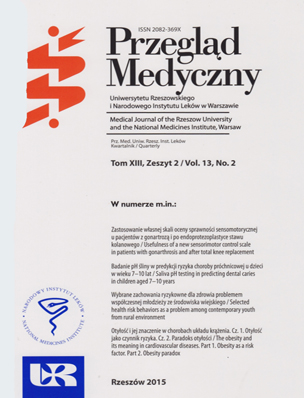
Saliva pH testing in predicting dental caries in children aged 7–10 years
DOI:
https://doi.org/10.15584/przmed.2015.2.2Keywords:
dental caries, saliva, public healthAbstract
Introduction: Dental caries remains the most widespread disease of the masticatory system. According to WHO and FDI reports, the epidemic of dental caries has not been reduced. In Poland, dental caries prevalence among children remains high and is among the highest in Europe.
Aims: 1. to assess the values of saliva pH testing used as a screening test for assessing the risk of dental caries in children. 2. to assess the correlation of saliva pH testing with the condition of the oral cavity, expressed by means of the DMF index.
Material, methods: The research group consisted of 128 children aged 7–10 years. The research involved: 1. a check-up performed by means of basic dental instruments. 2. assessment of patient’s saliva pH by means of a litmus paper. On the basis of the check-ups performed, the DMF index was established for each patient.
Results: 1. Presence of dental caries – 75.8%. 2. Percentage of children with missing teeth – 18%. 3. Percentage of children undergoing treatment – 79.7%. 4. Correlation value of the DMF index and saliva pH: 0.693; - 0.730 (p=0.000).
Conclusions: 1. The condition of health of the oral cavity in children aged 7–10 years is bad. 76% have been diagnosed with dental caries, 18% of children have at least one missing tooth. 2. Saliva pH testing is highly correlated with active dental caries, thus it can be a useful self-control test for assessing the condition of health of the oral cavity in children.
Downloads
References
Krawczyk D, Sikorska-Jaroszynska MH, Mielnik- Błaszczak M, et al. Dental caries and total antioxidant status of unstimulated mixed whole saliva in patients aged 16-23 years. Adv Med Sci 2012; 57: 163-8. doi:10.2478/v10039-012-0015-9
Janczuk Z. Caries prevention in children and adolescents in Poland and the realization of the WHO health goals. The possibility of realization till the year 2000. Czas Stomatol 1988; 41:193-7.
Shrestha A, Mohamed-Tahir M, Hegde J, et al. Caries-risk assessment with a chairside optical spectroscopic sensor by monitoring bacterial-mediated acidogenic-profile of saliva in children. J Conserv Dent 2012;14: 395-400.
Culp DJ, Robinson B, Parkkila S, et al. Oral colonization by Streptococcus mutans and caries development is reduced upon deletion of carbonic anhydrase VI expression in saliva. Biochim Biophys Acta 2011; 1567-76. doi:10.1016/j.bbadis.2011.09.006
Yang F, Zeng X, Ning K, et al. Saliva microbiomes distinguish caries-active from healthy human populations. ISME J 2012; 6:1-10. doi:10.1038/ismej.2011.71
Preethi BP, Reshma D, Anand P. Evaluation of Flow Rate, pH, Buffering Capacity, Calcium, Total Proteins and Total Antioxidant Capacity Levels of Saliva in Caries Free and Caries Active Children: An In Vivo Study. Indian J Clin Biochem 2011; 25: 425-8. doi: 10.1007/s12291-010-0062-6
Denny PC. A saliva-based prognostic test for dental caries susceptibility. J Dent Hyg 2009; 83: 175-6.
Ahmadi-Motamayel F, Goodarzi M, Hendi S, et al. Total antioxidant capacity of saliva and dental caries. Med Oral Patol Oral Cir Bucal 2013; 18: 553-6. doi:10.4317/medoral.18762
Zimmer S, Bizhang M, Barthel C, et al. Caries risk assessment - are saliva tests as well as microbiological and clinical test procedures worthwhile? Gesundheitswesen 2008; 70: 702-6.
Stec M, Pypeć J. Ocena intensywności próchnicy oraz częstości występowania zaburzeń rozwojowych uzębienia u dzieci i młodzieży z jedno- lub obustronnym rozszczepem wargi, wyrostka zębodołowego i/lub podniebienia. Czas. Stomat 2005; 58: 12
Nurelhuda NM, Al-Haroni M, Trovik TA, et al. Caries experience and quantification of Streptococcus mutans and Streptococcus sobrinus in saliva of Sudanese schoolchildren. Caries Res 2010; 44: 402-7. doi: 10.1159/000316664
Sanchez-Garcia S, Gutierrez-Venegas G, Juarez-Cedillo T, et al. A simplified caries risk test in stimulated saliva from elderly patients. Gerodontology 2008; 25: 26-33. doi: 10.1111/j.1741-2358.2007.00184.x
Tayab T, Rai K, Kumari AV. Evaluating the physicochemical properties and inorganic elements of saliva in caries-free and caries-active children. An in vivo study. Eur J Paediatr Dent 2012;13:107-12.
Downloads
Published
How to Cite
Issue
Section
License
Copyright (c) 2015 Medical Journal of the Rzeszow University and the National Medicines Institute, Warsaw

This work is licensed under a Creative Commons Attribution 4.0 International License.
Our open access policy is in accordance with the Budapest Open Access Initiative (BOAI) definition: this means that articles have free availability on the public Internet, permitting any users to read, download, copy, distribute, print, search, or link to the full texts of these articles, crawl them for indexing, pass them as data to software, or use them for any other lawful purpose, without financial, legal, or technical barriers other than those inseparable from having access to the Internet itself.
All articles are published with free open access under the CC-BY Creative Commons attribution license (the current version is CC-BY, version 4.0). If you submit your paper for publication by the Eur J Clin Exp Med, you agree to have the CC-BY license applied to your work. Under this Open Access license, you, as the author, agree that anyone may download and read the paper for free. In addition, the article may be reused and quoted provided that the original published version is cited. This facilitates freedom in re-use and also ensures that Eur J Clin Exp Med content can be mined without barriers for the research needs.











