
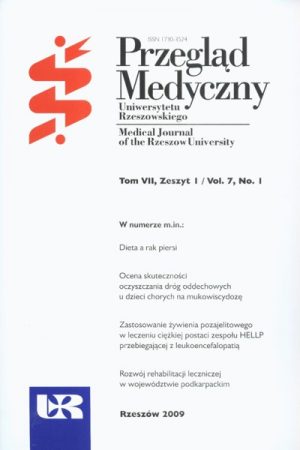
Diet and breast cancer
Keywords:
carbohydrates, lipids, obesity, alcohol, breast cancer, nutritionAbstract
Breast cancer is the most frequent cause of death from malignant tumors amongst women in Poland. There was 12049 new cases of malignant breast cancer and 4887 deaths caused by the disease in 2004 year. However prevention examinations such as mammography, ultrasonography and palpation examination allows for early detection of neoplasm's changes, breast cancer is still the main cause of death. The main predisposing factors for pronouncement of breast cancer are age, early menarche, first pregnancy in late age, or lack of pregnancy, short period of breast feeding , late menopause, family history as well as diet and mode of life. In opinion of oncologists, about one third of tumor case diseases’ reasons, are errors in nutrition, so even small changes in diet can decrease risk of breast cancer. Amount and kind of consumed fat has major influence . It exerts protecting influence of long chain unsaturated fatty acids on development of breast cancer. There is a correlation between BMI and breast cancer risk. Obesity increases the risk of local recurrence of cancer process and also has an influence on survival without any syndromes of disease. Limits of food’ s caloricity as well as increase of physical activity causes reduction of body mass which is connected with decreased risk of cancer. Besides, increased consumption of carbohydrates correlates with increased morbidity risk. Observation research show that regular physical activity, maintaining of proper body weight and limitation of alcohol intake in diet allows to reduce breast cancer risk.
Downloads
References
Krajowy Rejestr Nowotworów Centrum Onkologii – Instytut im. Marii Curie-Skłodowskiej http://85.128.14.124/krn
Michels K.B., Mohllajee A.P., Roset- Bahmanyar E., Beehler GP, Moysich KB.: Diet and breast cancer. A review of the prospective observational studies, Cancer 2007; 109: 2712–2749
Pawlicki M.: Rak piersi – nowe nadzieje i możliwości leczenia α medica Press, Bielsko Biała, 2002, Wyd. I
Li Ch.I., Daling J.R., Malone K.E.: Relationship between established breast cancer risk factors and risk of seven different histologic types of invasive breast cancer, Cancer Epidemiol Biomarkers Prev 2006; 15: 946– 954.
Suzuki R., Ye W., Rylander-Rudqvist T., Rylander-Rudqvist T, Saji S, Colditz G.A., Wolk A.: Alcohol and postmenopausal breast cancer risk depended by estrogen and progesterone receptor status: a prospective cohort study, J Natl Cancer Inst, 2005; 97: 1601–1608.
Dorgan J.F., Baer D.J., Albert P.S., Judd J.T., Brown E.D., Corle D.K., Serum hormones and the alcohol-breast cancer association in postmenopausal women, J atl Cancer Inst. 2001; 93: 710–715.
Fan S., Meng Q., Gao B. Grossman J., Yadegari M., Goldberg I.D.: Alcohol stimulates estrogen receptor signaling in human breast cancer cell lines, Cancer Res 2000; 60: 5635–5639.
Singletary K.W., Frey R.S., Yan W.: Effect of ethanol on proliferation and estrogen receptor-alpha expression in human breast cancer cells, Cancer Lett 2001; 165: 131–137.
Ginsburg E.S., Walsh B.W., Shea B.F. Gao X., Gleason R.E., Barbieri R.L.: The effects of ethanol on the clearance of estradiol in postmenopausal women, Fertil Steril 1995; 63: 1227–1230.
Campbell K.L., McTiernan A.: Exercises and biomarkers for cancer prevention studies, J Nutr 2007; 137: 161–169.
Holmes M.D., Willet W.C. Does diet affect breast cancer risk? Breast Cancer Res 2004; 6: 170–178.
Ciok J., Dolna A.: Indeks glikemiczny a choroby nowotworowe, Współcz Onkol 2005; 9: 183–188.
Augustin L.S.A., Dal Maso L., LaVecchia C., Parpinel M., Negri E., Vaccarella S.: Dietary glycemic index and glycemic load, and breast cancer risk: A case-control study Ann Oncol 2001;12: 1533–1538.
Jonas C.R., McCullough M.L., Teras L.R., Walker-Thurmond K.A., Thun M.J., Calle E. E.: Dietary Glycemic Index, Glycemic Load, and Risk of Incident Breast Cancer in Postmenopausal Women. Cancer Epidemiology, Biomarkers & Prevention, 2003;12: 573–577.
Agurs-Collins T., Adams-Campbell L.L., Kim K.S., Cullen K.J.: Insulin-like growth factor-I and breast cancer risk in post-menopausal African-American women, Cancer Detect. Prev, 2000; 24: 199–206.
Yang G., Lu G., Jin F., Dai Q., Best R., Shu X.: Population-based, case-control study of blood C-peptide level and breast cancer risk. Cancer Epidemiol. Biomark, Prev., 2001; 10:1207–1211.
Clarke R., Dickson R.B., Lippman M.E.: Hormonal aspects of breast cancer. Growth factors, drugs and stromal interactions, Crit Rev Oncol Hematol, 1992; 12: 1–23].
Tavani A., Giordano L., Gallus S., Talamini R., Franceschi S., Giacosa A.: Consumption of sweet foods and breast cancer risk in Italy, Ann Oncol, 2006; 17: 341–345.
Potischman N., Coates R.J., Swanson C.A., Carroll R.J., Daling J.R., Brogan D.R.: Increased risk of early-stage breast cancer related to consumption of sweet foods among women less than age 45 in the United States, Cancer Causes Control 2002; 13: 937–946.
Lubin J.H., Burns P.E., Blot W.J., Ziegler R.G., Lees A.W., Fraumeni J.F. Jr: Dietary factors and breast cancer risk, Int J Cancer 1981; 28: 685–689.
Landa M.C., Frago N., Tres A.: Diet and the risk of breast cancer in Spain. Eur J Cancer Prev 1994; 3: 313–320.
Cho E., Spiegelman D., Hunter D.J., Chen W.Y., Stampfer M.J., Colditz G.A., Willett W.C.: Premenopausal fat intake and risk of breast cancer, J Natl Cancer Inst. 2003;95:1079–85.
Kushi L., Giovannucci E.: Dietary fat and cancer, Am J Med. 2002;113:63–70.
McPherson K., Steel C.M., Dixon J.M.: ABC of breast diseases. Breast cancer-epidemiology, risk factors, and genetics, BMJ. 2000;321:624–8.
Willett W.C. Diet and breast cancer. J Intern Med. 2001; 249:395–411
http://rex.nci.nih.gov/NCI_Pub_Interface/raterisk/risks120.html
Bernard-Gallon D.J., Vissac-Sabatier C., Antoine-Vincent D., Rio P.G., Maurizis J.C., Fustier P., Bignon Y.J.: Differential effects of n-3 and n-6 polyunsaturated fatty acids on BRCA1 and BRCA2 gene expression in breast cell lines, Br J Nutr. 2002;87:281–9.
Maizes V.: Reducing the risk of breast cancer, Nutrition-al strategies. Explore (NY). 2005;1:130–2.
Tsujita-Kyutoku M., Yuri T., Danbara N., Senzaki H., Kiyozuka Y., Uehara N., Takada H., Hada T., Miyazawa T., Ogawa Y., Tsubura A.: Conjugated docosahexaenoic acid suppresses KPL-1 human breast cancer cell growth in vitro and in vivo: potential mechanisms of action, Breast Cancer Res. 2004;6:291–9.
Boyd N.F., Stone J., Vogt K.N., Connelly B.S., Martin L.J., Minkin S.: Dietary fat and breast cancer risk revisited: a meta-analysis of the published literature, Br J Cancer. 2003;89:1672–85
Thiébaut A.C., Kipnis V., Chang S.C., Subar A.F., Thompson F.E., Rosenberg P.S., Hollenbeck A.R., Leitzmann M., Schatzkin A.: Dietary fat and postmenopausal invasive breast cancer in the National Institutes of Health-AARP Diet and Health Study cohort, J Natl Cancer Inst. 2007;99:451–62.
Wirfält E., Mattisson I., Gullberg B., Johansson U., Olsson H., Berglund G.: Postmenopausal breast cancer is associated with high intakes of omega-6 fatty acids (Sweden), Cancer Causes Control. 2002;13:883–93.
Holmes M.D., Hunter D. J., Colditz G.A., Stampfer M.J., Hankinson S.E., Speizer F.E., Rosner B., Willett W.C. Association of Dietary Intake of Fat and Fatty Acids With Risk of Breast Cancer, JAMA 1999 281:914–920.
Kim E.H.J., Willett W.C., Colditz G.A., Hankinson S.E., Stampfer M.J., Hunter D.J., Rosner B., Holmes M.D.: Dietary Fat and Risk of Postmenopausal Breast Cancer in a 20-year Follow-up. Am J Epidemiol 2006 164:990–997.
Löf M., Sandin S., Lagiou P., Hilakivi-Clarke L., Trichopoulos D., Adami H.O., Weiderpass E.: Dietary fat and breast cancer risk in the Swedish women's lifestyle and health cohort, Br J Cancer. 2007;97:1570–6.
Binukumar B.: Mathew A. Dietary fat and risk of breast cancer. World J Surg Oncol. 2005;18:45
Michels K.B., Mohllajee A.P., Roset-Bahmanyar E. i wsp.: Diet and breast cancer. A review of the prospective observational studies, Cancer, 2007; 109: 2712– 2749.
Carmichael A.R.: Obesity and prognosis of breast cancer Obesity Reviews, 2006;7: 333–340.
Frączek J., Herman K., Łobaziewicz W.: Wpływ wskaźnika masy ciała na rokowanie kobiet leczonych operacyjnie z powodu raka piersi, Współcz Onkol., 2004; 8: 239–244.
Fair A.M., Dai Q., Shu X.O. Matthews Ch.E., i wsp. Energy balance, insulin- resistance biomarkers and breast cancer risk. Cancer Detect Prev. 2007, 31: 214–219.
Lorincz A.M., Sukumar S.: Molecular links between obesity and breast cancer, Endocrine-Related Cancer, 2006; 13: 279–292.
Dizdar Ö., Alyamac E.: Obesity: an endocrine tumor?. Medical Hypotheses, 2004; 63:790–792.
Thorand B., Kohlmeier L., Simonsen N. i wsp.: Intake of fruits, vegetables, folic acid and related nutrients and risk of breast cancer in postmenopausal women, Public Health Nutrition 1998; 3: 14 7–156.
Larsson S.C., Giovannucci E., Wolk A.: Folate and risk of breast cancer: a meta-analysis, J Natl Cancer Inst 2007;99: 64– 76.
Lajous M., Lazcano-Ponce E., Hernandez-Avila M.: Folate, vitamin B6, and vitamin B12 intake and the risk of breast cancer among mexican women, Cancer Epidemiol Biomarkers Prev 2006; 15: 443–448.
Zhang S., Hunter D.J., Forman M., R.: Dietary carotenoids and vitamins A, C and E and risk of breast cancer, Journal of the National Cancer Institute, 1999; 91: 547–556.
Shin M-H., Holmes M.D, Hankinson S.E.: Intake of dairy products, calcium, and vitamin D and risk of breast cancer, Journal of the National Cancer Institute, 2002; 94: 1301–1311.
Downloads
Published
How to Cite
Issue
Section
License
Copyright (c) 2009 Medical Journal of the Rzeszow University

This work is licensed under a Creative Commons Attribution 4.0 International License.
Our open access policy is in accordance with the Budapest Open Access Initiative (BOAI) definition: this means that articles have free availability on the public Internet, permitting any users to read, download, copy, distribute, print, search, or link to the full texts of these articles, crawl them for indexing, pass them as data to software, or use them for any other lawful purpose, without financial, legal, or technical barriers other than those inseparable from having access to the Internet itself.
All articles are published with free open access under the CC-BY Creative Commons attribution license (the current version is CC-BY, version 4.0). If you submit your paper for publication by the Eur J Clin Exp Med, you agree to have the CC-BY license applied to your work. Under this Open Access license, you, as the author, agree that anyone may download and read the paper for free. In addition, the article may be reused and quoted provided that the original published version is cited. This facilitates freedom in re-use and also ensures that Eur J Clin Exp Med content can be mined without barriers for the research needs.











