
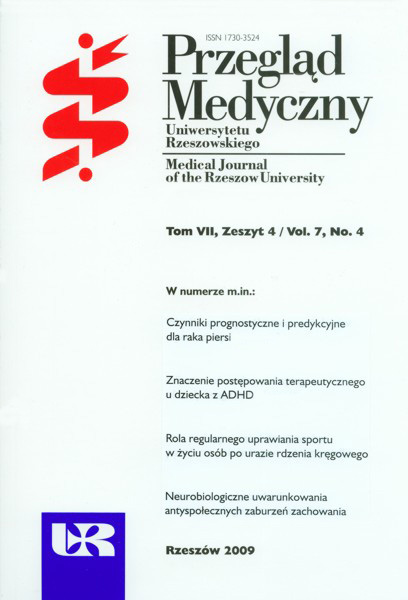
Neurobiological determinants of antisocial behavior
Keywords:
antisocial behavior, prefrontal cortex, moral reasoningAbstract
Understanding the role which is played by a factors determining development of antisocial disorders, is an important issue, both for cognitive and socio-economic reasons. In the past years the researchers were concentrated mostly on influence of psychosocial determinants of personality disorders. Recently they are distinctively concerned with the neurobiological basis to antisocial and aggressive behavior. The developing field of neuroscience is beginning to provide important insights into the neural mechanisms that underlie the cognitive and affective processes involved in antisocial behavior. As it is widely known, common feature of the antisocial and rule-breaking behavior is the failure to follow moral guidelines. Authors of this paper give a review which summarizes key findings from brain imaging re-search on both antisocial behavior. The key areas which found to be functionally or structurally impaired in antisocial populations include dorsal and ventral regions of the prefrontal cortex (PFC), amygdala, hippocampus, angular gyrus, anterior cingulate and temporal cor-tex. Also regions most commonly activated in moral judgment process consist of the polar/medial and ventral PFC, amygdala, angular gyrus and posterior cingulate. It is hypothesized that the rule-breaking behavior common to antisocial, violent and psychopathic individuals is a result of impairments in some of the structures (dorsal and ventral PFC, amyg-dala and angular gyrus) determining moral cognition and emotion processes. Impairments to the emotional component that comprises the feeling of what is moral is viewed as the primary deficit in antisocials, although some disruption to the cognitive and emotional components of morality (particularly selfreferential thinking and emotion regulation) cannot be ruled out. While this neurobiological predisposition is likely only one of several biosocial processes involved in the etiology of antisocial behavior, it raises significant moral issues for the legal system and medical ethics.
Downloads
References
Perenc L. (2009), Rozwój somatyczny dzieci i młodzieży w świetle współczesnych badań. Young Sports Science of Ukraine, Lvov, 2009, 13, 4, 148.
Radochońska A., Perenc L. (2009), Trendy w rozwoju fizycznym u dzieci i młodzieży z Rzeszowa w 25-leciu 1978-2004. Przegląd Medyczny Uniwersytetu Rzeszowskiego, 2009, tom VII, z. 3, 239–250.
Raine A., Buchsbaum M., LaCasse L. (1997). Brain abnormalities in murderers indicated by positron emission tomography. Biological Psychiatry, 42, 495–508.
Oder W., Goldenberg G., Spatt J., Podreka I., Binder H., Deecke L. (1992). Behavioural and psychosocial and regional cerebral blood flow: a SPECT study. Journal of Neurology, Neurosurgery, and Psychiatry, 55, 475–80.
Gerra G., Calbiani B., Zaimovic A., et al. (1998). Regional cerebral blood flow and comorbid diagnosis in abstinent opioid addicts. Psychiatry Research, 26, 117–26.
Soderstrom H., Hultin L., Tullberg M., Wikkelso C., Ekholm S., Forsman A. (2002). Reduced frontotemporal perfusion in psychopathic personality. Psychiatry Research Neuroimaging, 114, 81–94.
Yang Y., Raine A., Lencz T., Bihrle S., LaCasse L., Colletti P. (2005). Volume reduction in prefrontal gray matter in unsuccessful criminal psychopaths. Biological Psychiatry, 57, 1103–8.
Kruesi M.J.P., Casanova M.F., Mannheim G., Johnson-Bilder A. (2004). Reduced temporal lobe volume in early onset conduct disorder. Psychiatry Research Neuroimaging, 132, 1–11.
Brower M.C., Price B.H. (2001), Advances in neuropsychiatry: neuropsychiatry of frontal lobe dysfunction in violent and criminal behaviour: a critical review. Journal of Neurology, Neurosurgery, and Psychiatry, 71, 720–726.
Laakso M.P., Gunning-Dixon F., Vaurio O., Repo-Tiihonen E., Soininen H., Tiihonen J. (2002). Prefrontal volumes in habitually violent subjects with antisocial personality disorder and type 2 alcoholism. Psychiatry Research: Neuroimaging, 114, 95–102.
Juhasz C., Behen M.E., Muzik O., Chugani D.C., Chugani H.T. (2001), Bilateral medial prefrontal and temporal neocortical hypometabolism in children with epilepsy and aggression. Epilepsia, 42, 991–1001.
Pietrini P., Guazzelli M., Basso G., Jaffe K., Grafman J. (2000), Neural correlates of imaginal aggressive behavior assessed by positron emission tomography in healthy subject. American Journal of Psychiatry, 157, 1772–81.
Gomez-Beldarrain M., Harries C., Garcia-Monco J.C., Ballus E., Grafman J. (2004). Patients with right frontal lesions are unable to assess and use advice to make predictive judgments. Journal of Cognitive Neuroscience, 16, 74–89.
Barkataki I., Kumari V., Das M., Taylor P., Sharma T. (2006), Volumetric structural brain abnormalities in men with schizophrenia or antisocial personality disorder. Behavioral Brain Research, 15, 239–47.
Goethals I., Audenaert K., Jacobs F., et al. (2005). Brain perfusion SPECT in impulsivity-related personality disorders. Behavioral Brain Research, 157, 187–92.
Hirono N., Mega M.S., Dinov I.D., Mishkin F., Cummings J.L. (2000), Left frontotemporal hypoperfusion is associated with aggression in patients with dementia. Archive of Neurology, 57, 861–6.
Kiehl K.A., Smith A.M., Mendrek A., Forster B.B., Hare R.D., Liddle P.F. (2004), Temporal lobe abnormalities in semantic processing by criminal psychopaths as revealed by functional magnetic resonance imaging. Psychiatry Research Neuroimaging, 130, 27–42.
Volkow N.D., Tancredi L.R., Grant C. et al. (1995), Brain glucose metabolism in violent psychiatric patients: A preliminary study. Psychiatry Research: Neuroimaging, 61, 243–53.
Soderstrom H., Tullberg M., Wikkelsoe C., Ekholm S., Forsman A. (2000), Reduced regional cerebral blood flow in non-psychotic violent offenders. Psychiatry Research: Neuroimaging, 98, 29–41.
Tiihonen J., Hodgins S., Vaurio O. (2000), Amygdaloid volume loss in psychopathy. Society for Neuroscience Abstracts, 2017.
Critchley H.D., Simmons A., Daly E.M. et al. (2000), Prefrontal and medial temporal correlates of repetitive violence to self and others. Biological Psychiatry, 15, 928–34.
Muller J.L., Sommer M., Wagner V. et al. (2003), Abnormalities in emotion processing within cortical and subcortical regions in criminal psychopaths: evidence from a functional magnetic resonance imaging study using pictures with emotional content. Psychiatry Research Neuroimaging, 54, 152–162.
Kiehl K.A., Smith A.M., Hare R.D., Mendrek A., Forster B.B., Brink J. (2001), Limbic abnormalities in affective processing by criminal psychopaths as revealed by functional magnetic resonance imaging. Biological Psychiatry, 50, 677–84.
Damasio A. (1994), Descartes’ error: Emotion, reason, and the human brain, New York Putnam.
Anderson S.W., Bechara A., Damasio H., Tranel D., Damasio A.R. (1999). Impairment of social and moral behavior related to early damage in human prefrontal cortex. Nature Neuroscience, 2, 1032–7.
Borg J.S., Hynes C., Van Horn J., Grafton S., Sinnott-Armstrong W. (2006), Consequences, action, and intention as factors in moral judgments: an fMRI investigation. Journal of Cognitive Neuroscience, 18, 803–17.
Caspi A., McClay J., Moffitt T. et al. (2002), Role of genotype in the cycle of violence in maltreated children, Science, 297, 851–4.
U.S.v Hinckley, 525 F 1342 (Sup. Ct. 1981).
Geidd J. N. (1999), Brain development during childhood and adolescence: A longitudinal MRI study. Nature Neuroscience, 2, 861.
Sowell E. R., Thompson P.M., Tessner K. D., Toga A. W. (2001), Mapping continued brain growth and gray matter density reduction in dorsal frontal cortex: inverse relationships during postadolescent brain maturation. The Journal of Neuroscience, 21, 8819–8829.
Downloads
Published
How to Cite
Issue
Section
License
Copyright (c) 2009 Medical Journal of the Rzeszow University

This work is licensed under a Creative Commons Attribution 4.0 International License.
Our open access policy is in accordance with the Budapest Open Access Initiative (BOAI) definition: this means that articles have free availability on the public Internet, permitting any users to read, download, copy, distribute, print, search, or link to the full texts of these articles, crawl them for indexing, pass them as data to software, or use them for any other lawful purpose, without financial, legal, or technical barriers other than those inseparable from having access to the Internet itself.
All articles are published with free open access under the CC-BY Creative Commons attribution license (the current version is CC-BY, version 4.0). If you submit your paper for publication by the Eur J Clin Exp Med, you agree to have the CC-BY license applied to your work. Under this Open Access license, you, as the author, agree that anyone may download and read the paper for free. In addition, the article may be reused and quoted provided that the original published version is cited. This facilitates freedom in re-use and also ensures that Eur J Clin Exp Med content can be mined without barriers for the research needs.











