Between Silence and Speaking: the Representation of National Identity in Oksana Zabuzhko’s Poetry
DOI:
https://doi.org/10.15584/tik.2017.14Słowa kluczowe:
Oksana Zabużko, współczesna poezja ukraińska, tożsamość narodowa, generacja lat 80., język, milczenieAbstrakt
The article is focused on the problems of national identity, self-representation, and memory re-articulation in Oksana Zabuzhko’s poetry. Language, speaking, and word as well as silence are conceptualized as key concepts in verse by the 1980s generation of Ukrainian poets to whom Oksana Zabuzhko belongs. Speaking and silence in 1980s poetry can be treated not only as concepts or metaphors but also as a literary strategy or even as the form of resistance in the late Soviet era. The article is structured as the gradation of motives from speaking to silence in Zabuzhko’s poetry. The analyses includes the following subthemes: non-verbal language represented by sounds, gestures, and poses, verbal language as existing between sacrum and profanum, speechlessness, and silence.
Downloads
Bibliografia
Aheieva, Vira. 2003. Zhinochy Prostir: Feministychny Dyskurs Ukrains’koho Modernizmu. Kyiv: Fakt.
Aheieva, Vira. 2011. Apologiia Modernu: Obrys XX Viku: Statti ta Esei. Kyiv: Hrani-T. Bhabha, Homi. 1990. “Introduction: narrating the Nation”. In Nation and Narration, ed. Homi Bhabha. London and New York: Routledge: 291-322.
Grabowicz, George. 2005. Teksty i Masky. Kyiv: Krytyka.
Hall, Stuart. 1992. “The question of cultural identity”, in Hall, Stuart; Held, David; McGrew, Anthony, Modernity and its futures, Cambridge: Polity Press in association with the Open University: 274–316.
Hundorova, Tamara. 2005. Pisliachornobyl’s’ka Biblioteka: Ukrains’ky Literaturny Post-modern. Kyiv: Krytyka.
In a Different Light: A Bilingual Anthology of Ukrainian Literature. 2008. Translated into English by Virlana Tkacz as Performed by Yara Arts Group, edited by Olha Luchuk. Lviv: Sribne Slovo, 2008.
Moore, David Chioni. 2006. “Is the Post- in Postcolonial the Post- in Post-Soviet? Toward a Global Postcolonial Critique.” In Baltic Postcolonialism: A Critical Reader, ed. Violeta Kelertas. Amsterdam and New York: Rodopi: 11-43.
Morenets’, Volodymyr. 2010. Oksymoron: Literaturoznavchi Statti. Kyiv: Agrar-media-Group.
Nora, Pierre. 2014. Teperishnie, Natsiia, Pam’iat’, transl. Andrii Riepa. Kyiv: TOV “Vydavnytstvo KLIO”.
Pavlyshyn, M.J. 1992. “Postcolonial features in contemporary Ukrainian culture”. Australian Slavonic and East European Studies, vol 6, issue 2, pp. 41-55.
Ricoeur, Paul. 2004. Pamiat’, Istoriia, Zabveniie. Moskva: Izdatel’stvo Gumanitarnoi Literatury.
Semkiv, Rostyslav. 2012. “Ledi Godiva z krainy dulibiv.” In Literaturna Defiliada: Suchasna Ukrains’ka Krytyka Pro Suchasny Ukrains’ku Literaturu, ed. Volodymyr Panchenko, 404-427. Kyiv: Tempora.
Wallo (Shchur), Oleksandra. 2013. “Post-Soviet Women Writers and the National Imaginary, 1989-2009”. Ph.D. Dissertation. University of Illinois, Urbana-Champaign.
Zabuzhko, Oksana. 2013. Virshi: 1980-2013. Kyiv: Komora.
Zborovs’ka, Nila. 2005. ”Pertseptsiia feministky u zakhidnoievropeis’komu dyskursi i ukrayins’komu pys’mi.” Slovo i Chas 1: 50-61.
Pobrania
Opublikowane
Jak cytować
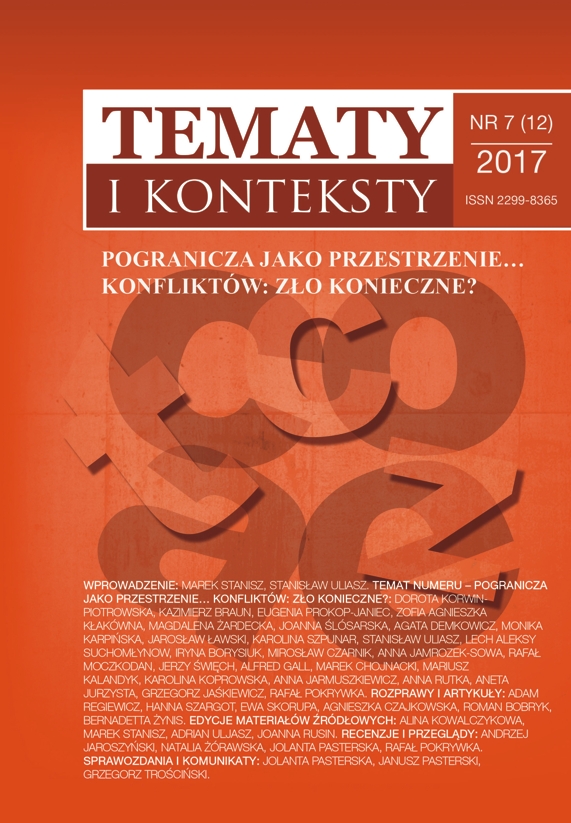
Numer
Dział
Licencja
Prawa autorskie (c) 2017 Tematy i Konteksty

Utwór dostępny jest na licencji Creative Commons Uznanie autorstwa – Użycie niekomercyjne – Bez utworów zależnych 4.0 Międzynarodowe.